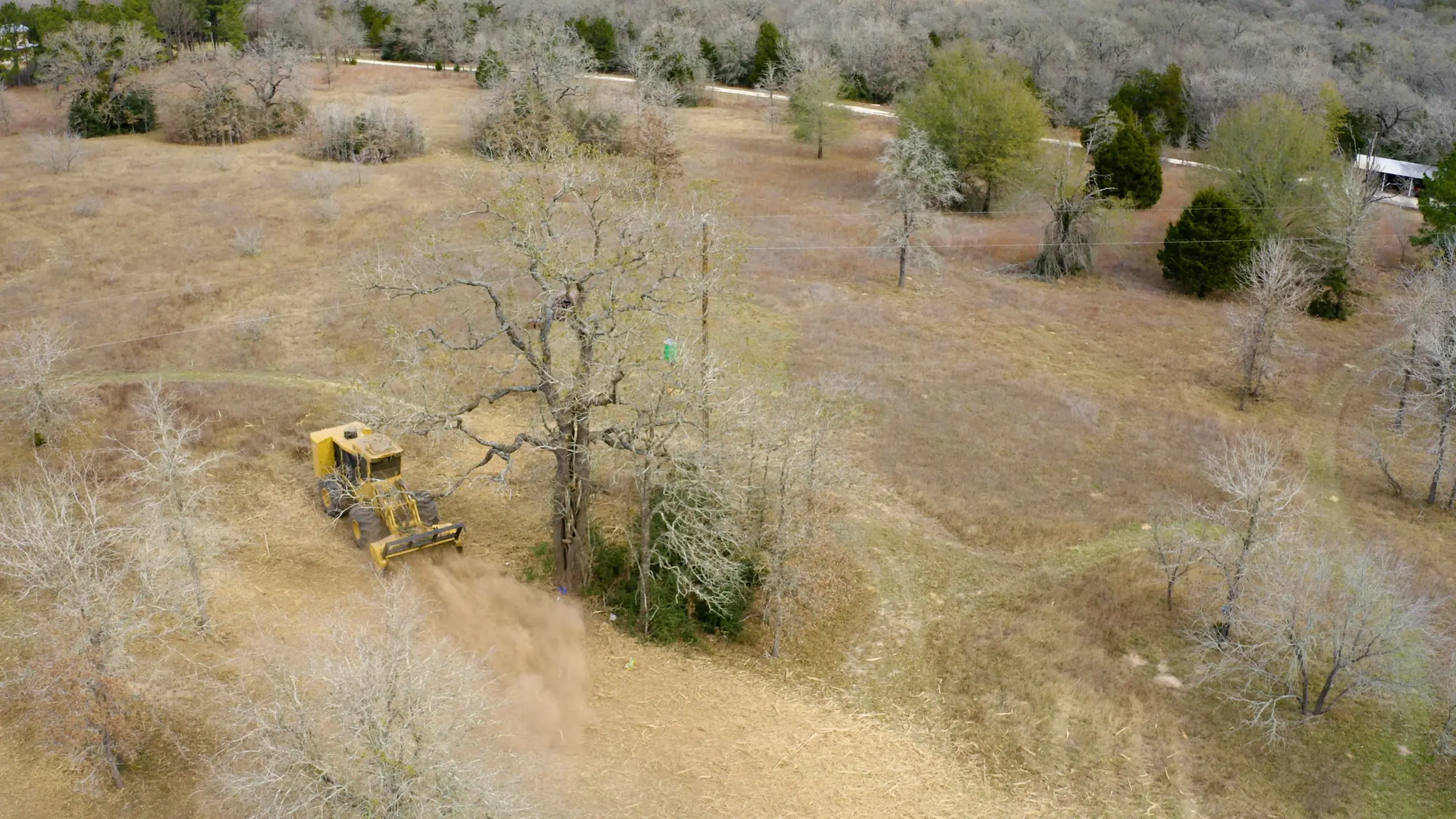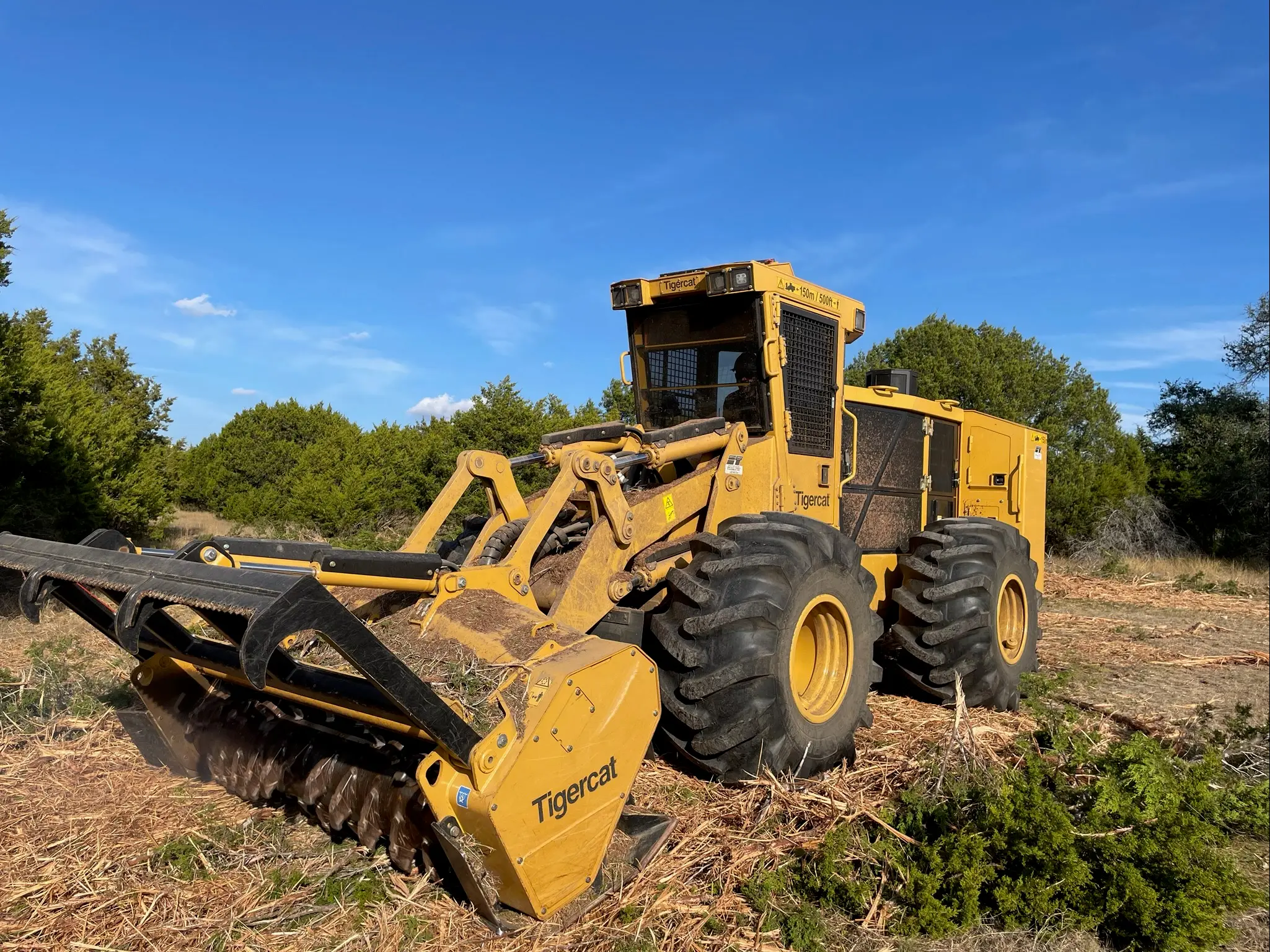
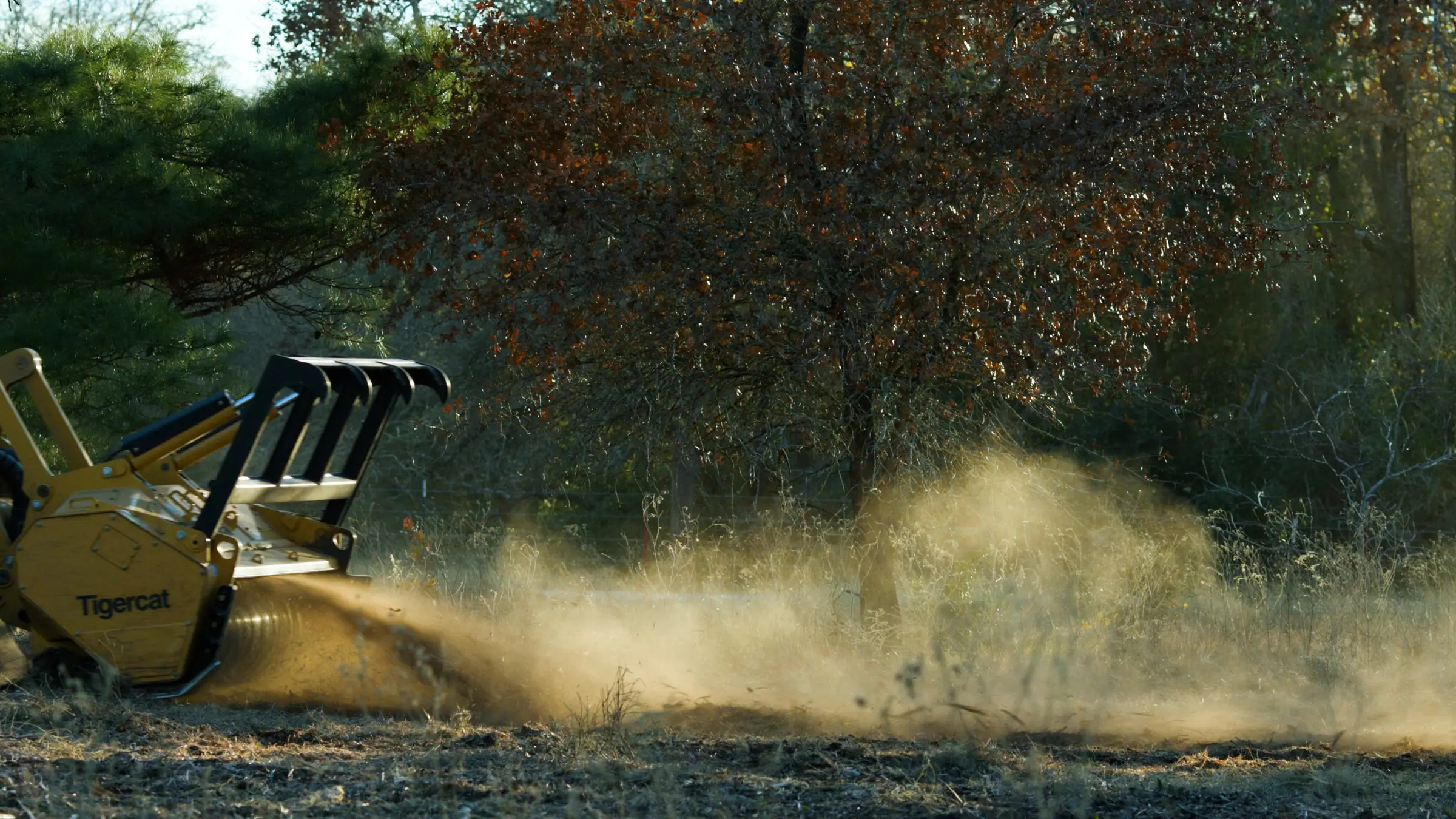
Tigercat mulching head throwing a dust plume as it grinds brush at ground level

Serving Bertram, Austin & Central Texas

Forestry mulching in Bertram, TX

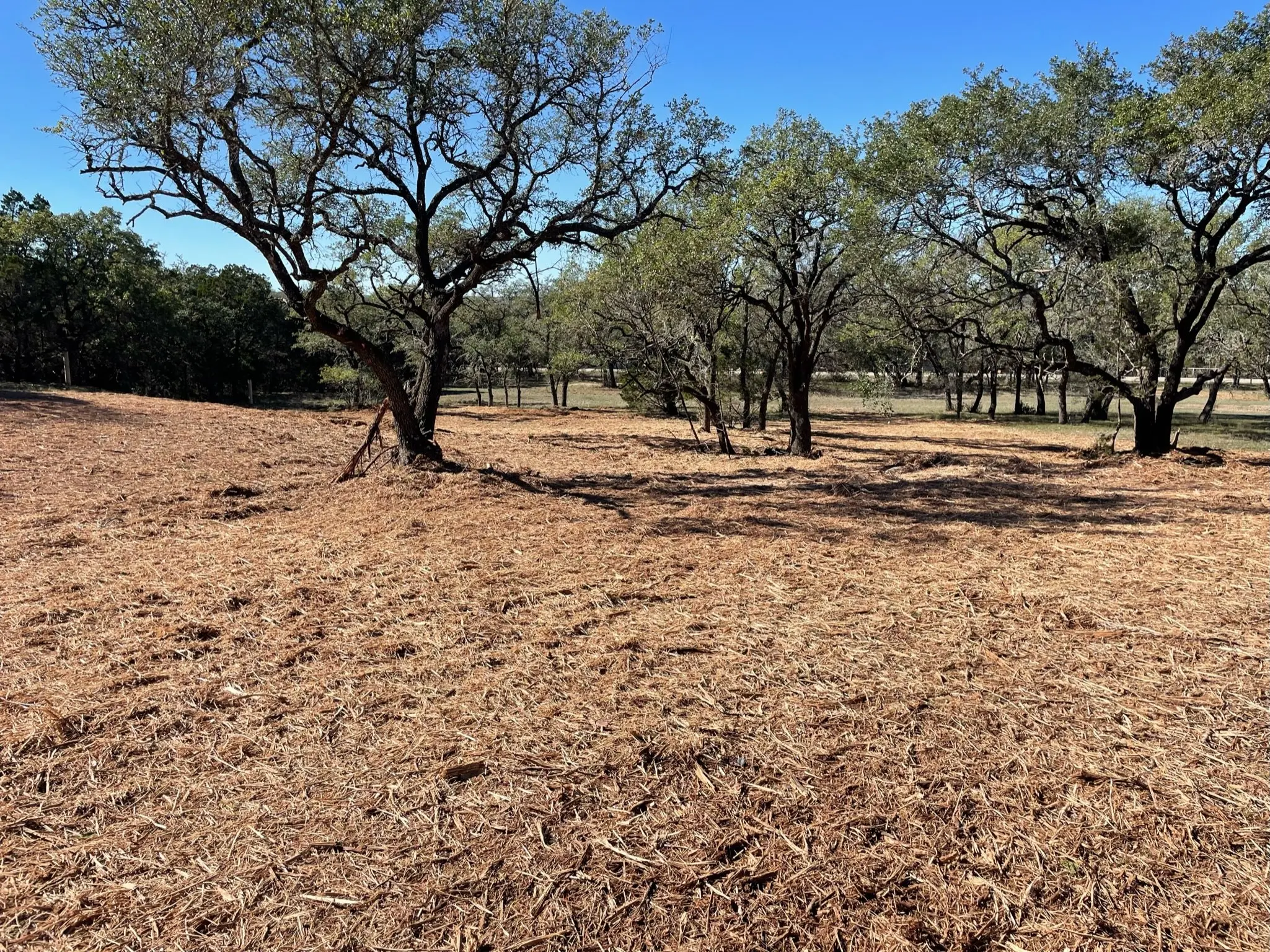
Brush, cedar and small trees ground into mulch right where they stand, with the trees you want left standing over clean, covered ground.

  • Free on-site estimates
  • Mon–Sat, 8:00am–5:00pm

Forestry mulching is the core of what Crosscut does, and it’s the main reason landowners in Bertram, TX and across Central Texas call us. A heavy machine with a spinning drum on the front, lined with teeth, grinds trees, stumps, logs, shrubs and woody brush into mulch, and that mulch stays on the ground as cover.

There’s no piling, no hauling and no burning, which means less mess and less liability than the old way of clearing. It works year round, keeps going through burn bans, and leaves the property looking open and park-like instead of scraped bare.

What the mulch does for your ground
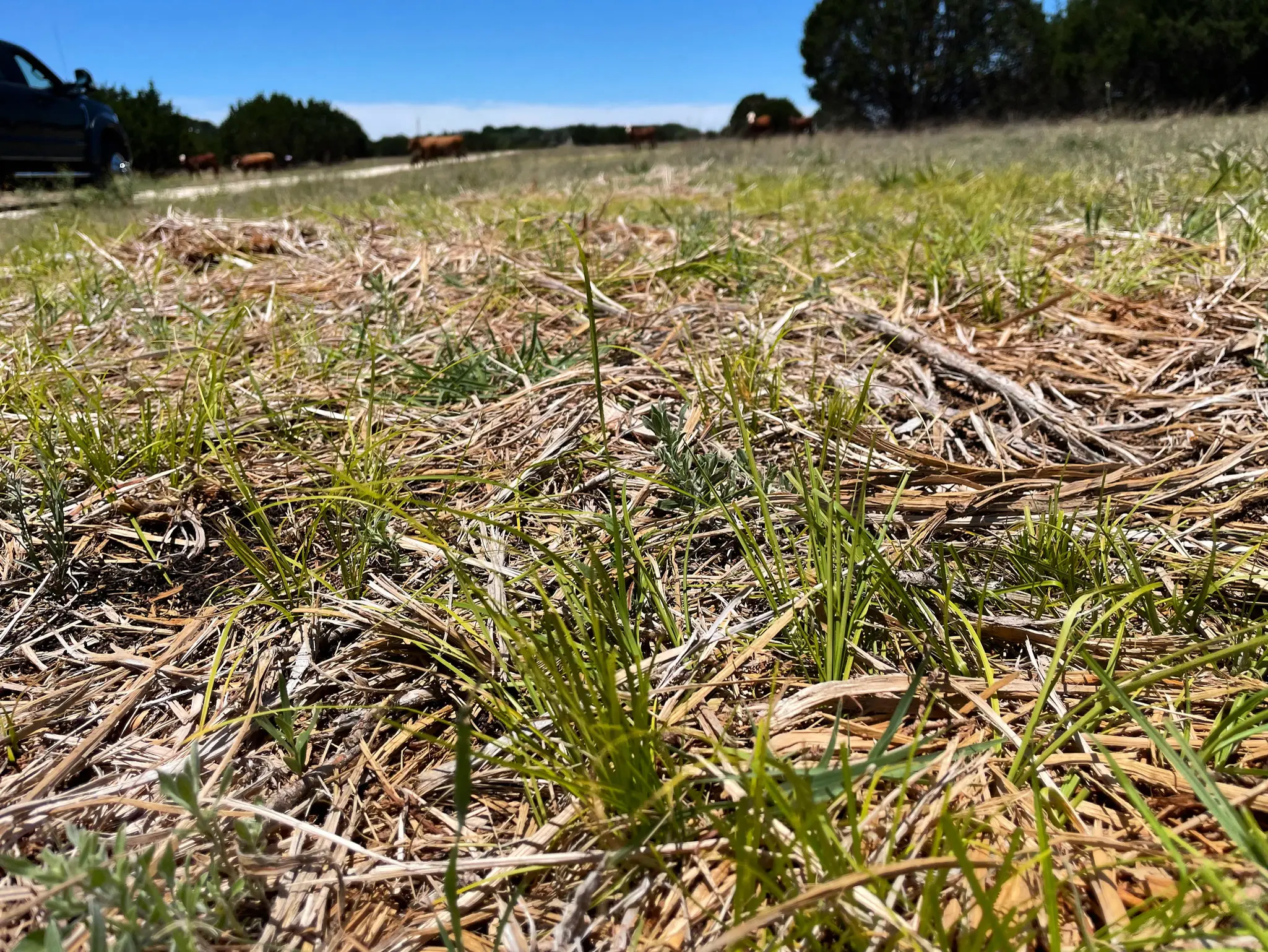
Green grass coming up through a fresh mulch layer

The mulch layer isn’t waste. It settles into the soil and keeps working long after the machines leave.

On a typical Hill Country tract, that means the ground under the cleared brush stays covered through the next dry spell and the next hard rain, instead of baking or washing away while you wait for grass.

  • Holds moisture in the soil, which matters most in a drought
  • Spreads organic matter evenly across the site
  • Keeps soil cooler than bare ground
  • Cuts erosion because root systems stay in the ground
  • Most species cut to the ground this way won’t re-sprout (mesquite is the exception)
  • Gives young planted trees a better shot at surviving and growing

Why mulching beats piling, hauling and burning

Push-and-pile clearing scrapes the topsoil, leaves bare dirt to wash away and hands you a stack of brush to deal with. Burning those piles means waiting on the weather and the county, and watching a fire. Hauling means trucks, trips and torn-up ground.

Mulching skips all of it. The ground stays covered, the roots that hold the soil stay put, and the work isn’t tied to a burn window. That’s a big reason it’s usually the most practical way to clear brush in the Hill Country.

Mosaic cutting and underbrush mulching

Not every job is a clean sweep. Mosaic cutting leaves clumps and islands of brush and trees in a pattern, so you open the ground but keep cover, shade and edges for wildlife. It’s a good fit for hunting land and for owners who want the property to still feel wild.

Underbrush mulching goes the other way: the canopy stays and everything crowding beneath it comes out. Under live oaks that usually means cedar, yaupon and scrub mulched down so you can see through the trees and walk under them again.

The two can be combined on one property. A homesite might get clean underbrush mulching close to the house and a mosaic cut farther out where the deer move.

Sloped clearing and tight spots
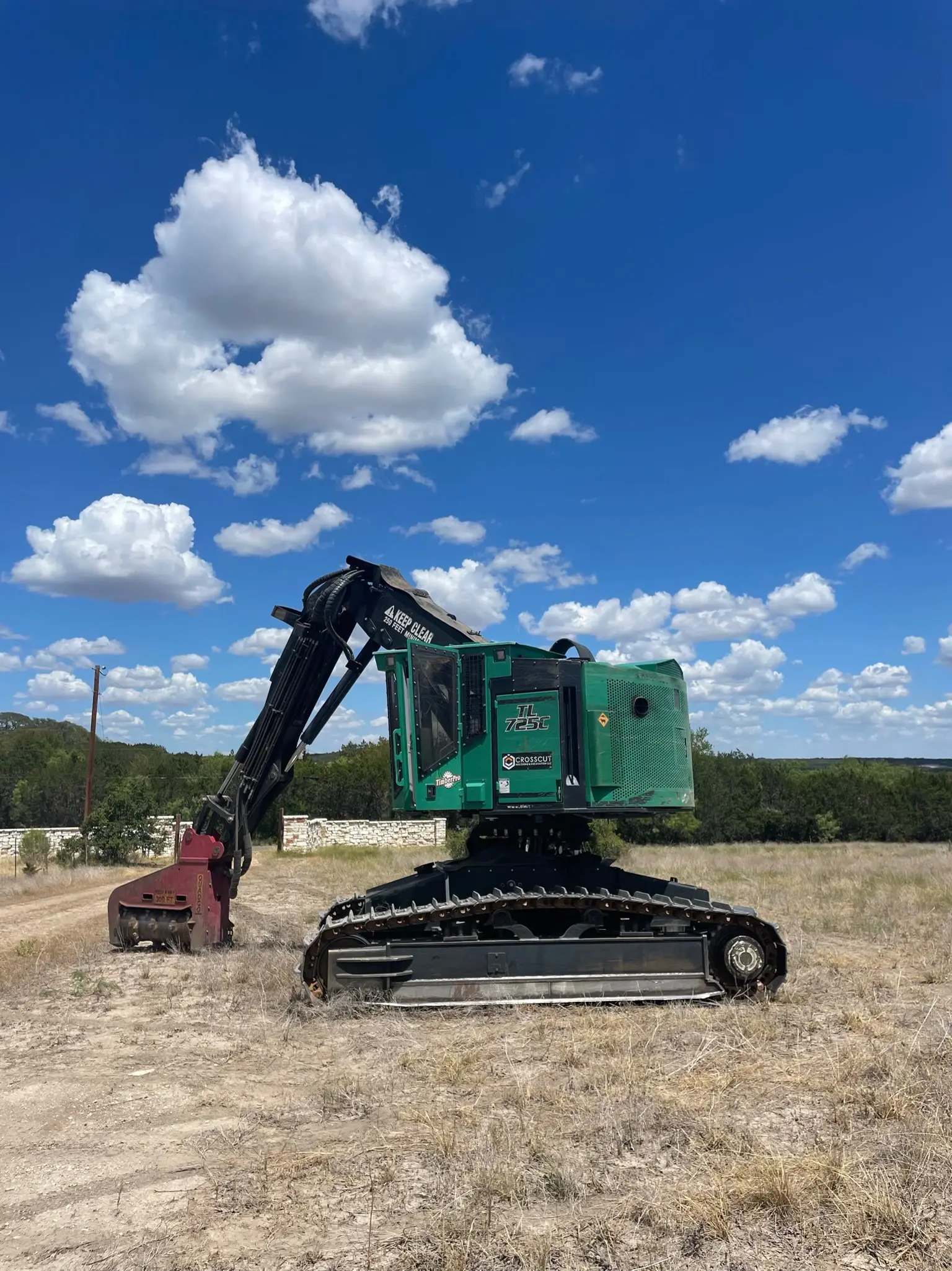
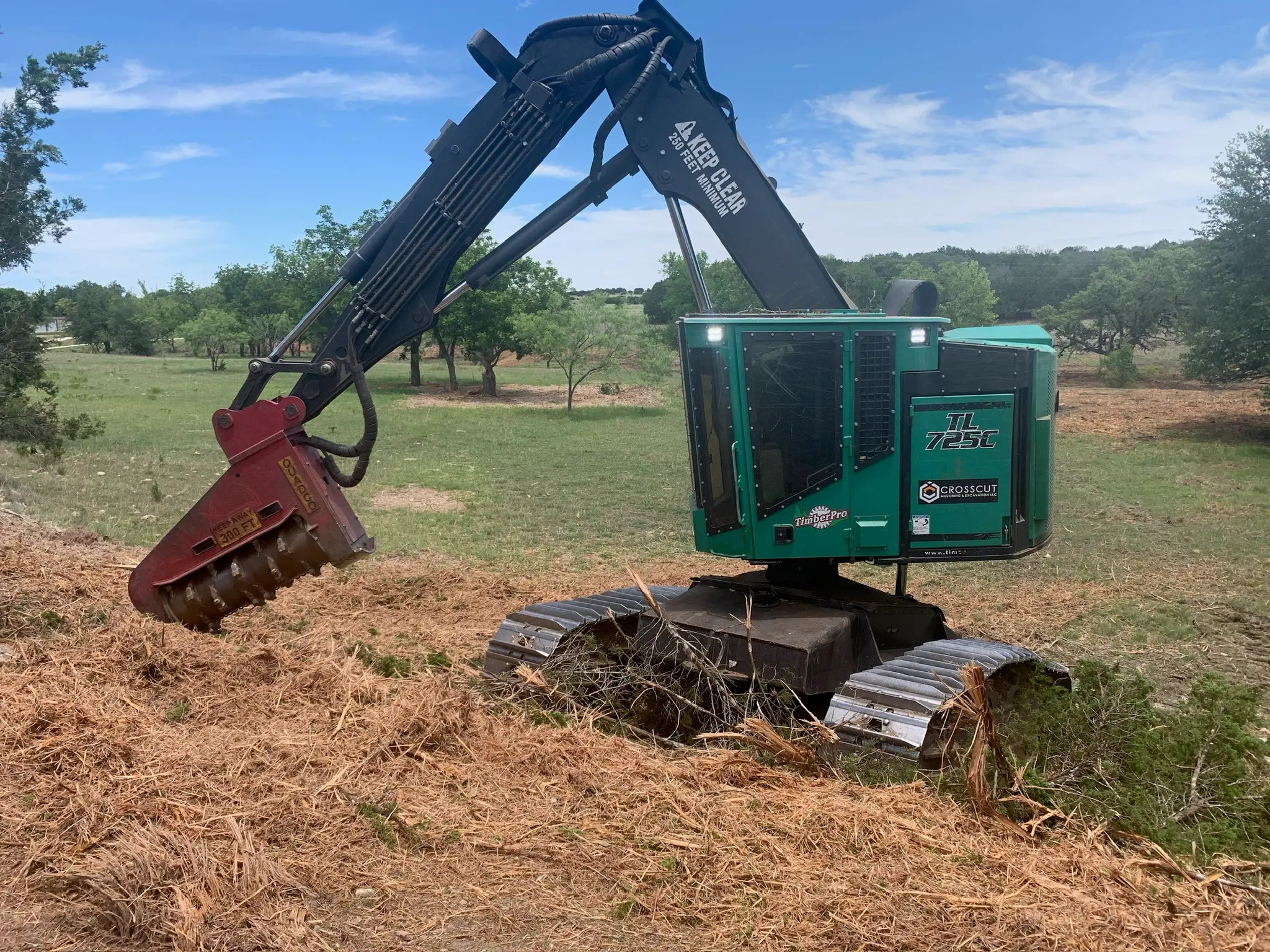
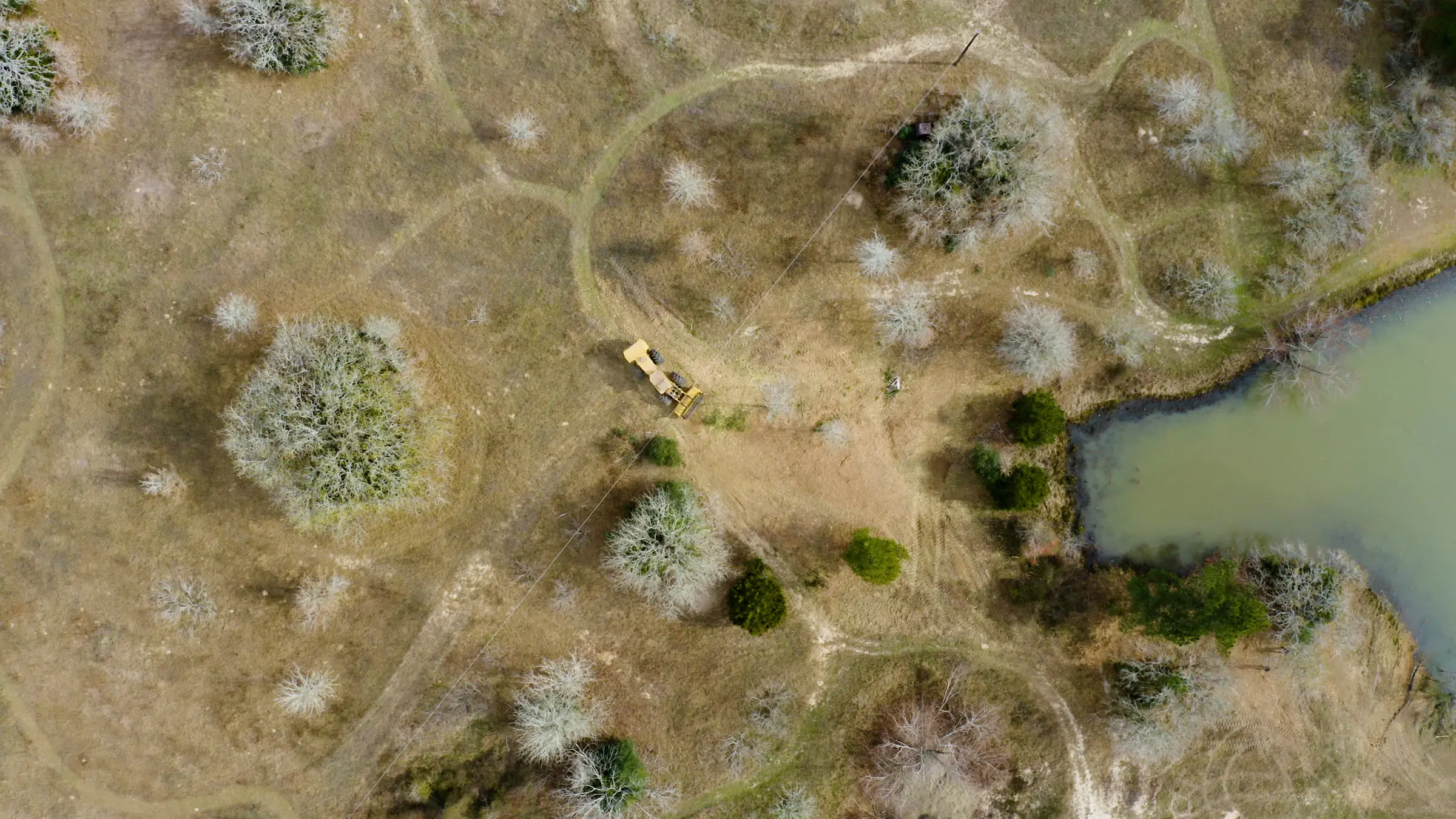
Timberpro TL725C working on a sloped mound of cleared ground

Hill Country ground is rarely flat. On steep, rocky slopes the Timberpro TL725C reaches out with a boom-mounted mulching head, so the tracks stay on solid footing while the head works the hillside. It can also reach over fences and drainages without crossing them.

On trails, fence rows and narrow openings, the Cat D1 dozer mulcher and the mulching heads on our Cat skid steers get into places a big machine can’t. A hand crew with chainsaws finishes around trunks and structures.

Matching the machine to the job

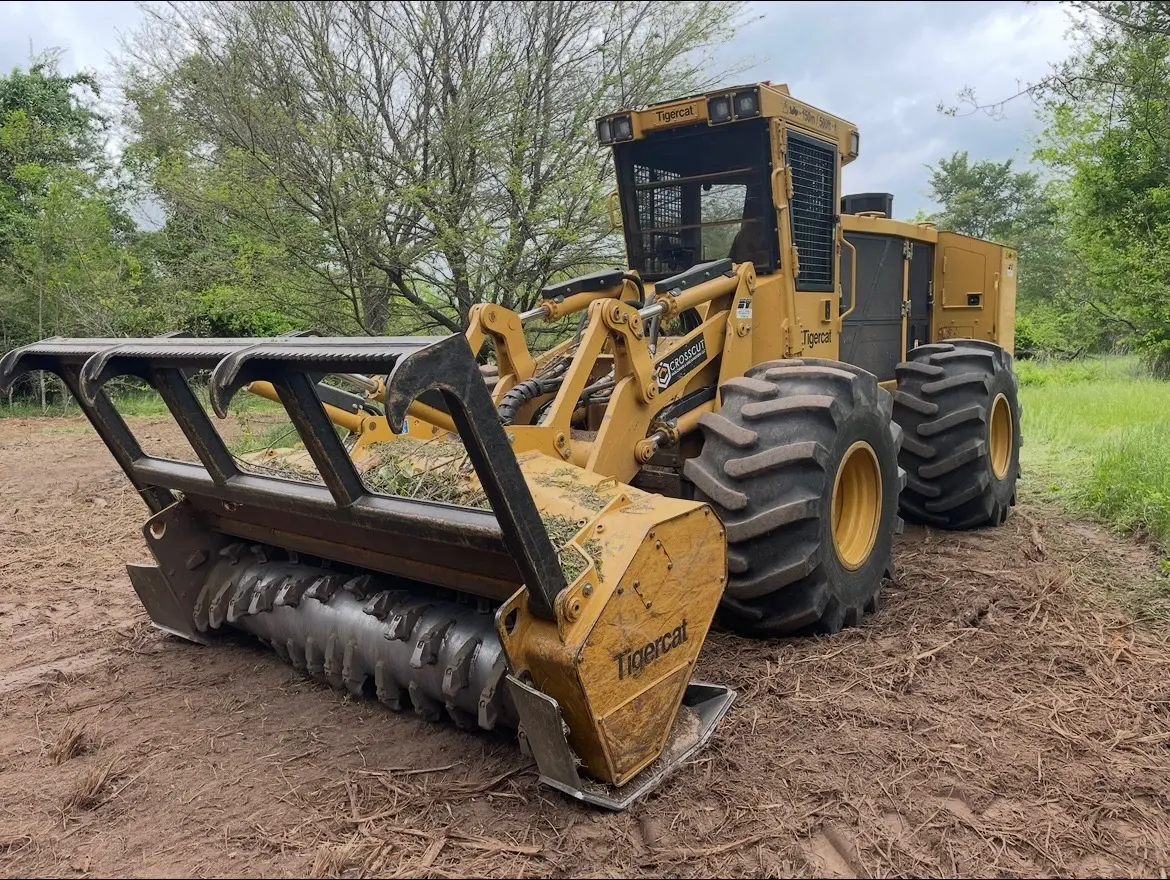
On dense cedar, thick yaupon and heavy brush across open acreage, the Tigercat M726G does the heavy lifting. On big jobs a smaller machine often follows it to fine-tune the finish and get that park look.

How fast it goes depends on density, terrain, tree size and the finish you want. That’s why an owner walks the property before you get a number or a schedule, and you’ll know which machine is coming and why.

Every mulching job also gets a hand crew on the details. Chainsaws handle the cedar tight against a keeper oak, the brush along a fence and anything close to a house or barn, so the machines can stay where they work best.

What the job can include

  • Forestry mulching
  • Cedar and underbrush mulching
  • Brush mulching
  • Mosaic cutting
  • Sloped clearing
  • Trail and lane mulching
  • Hand-crew finish work around trees and structures
Talk it through: (512) 890-2555

The iron for this job

What we bring for forestry mulching

The owner picks the machine on the walk-through, matched to your ground — not whatever happens to be on the trailer.

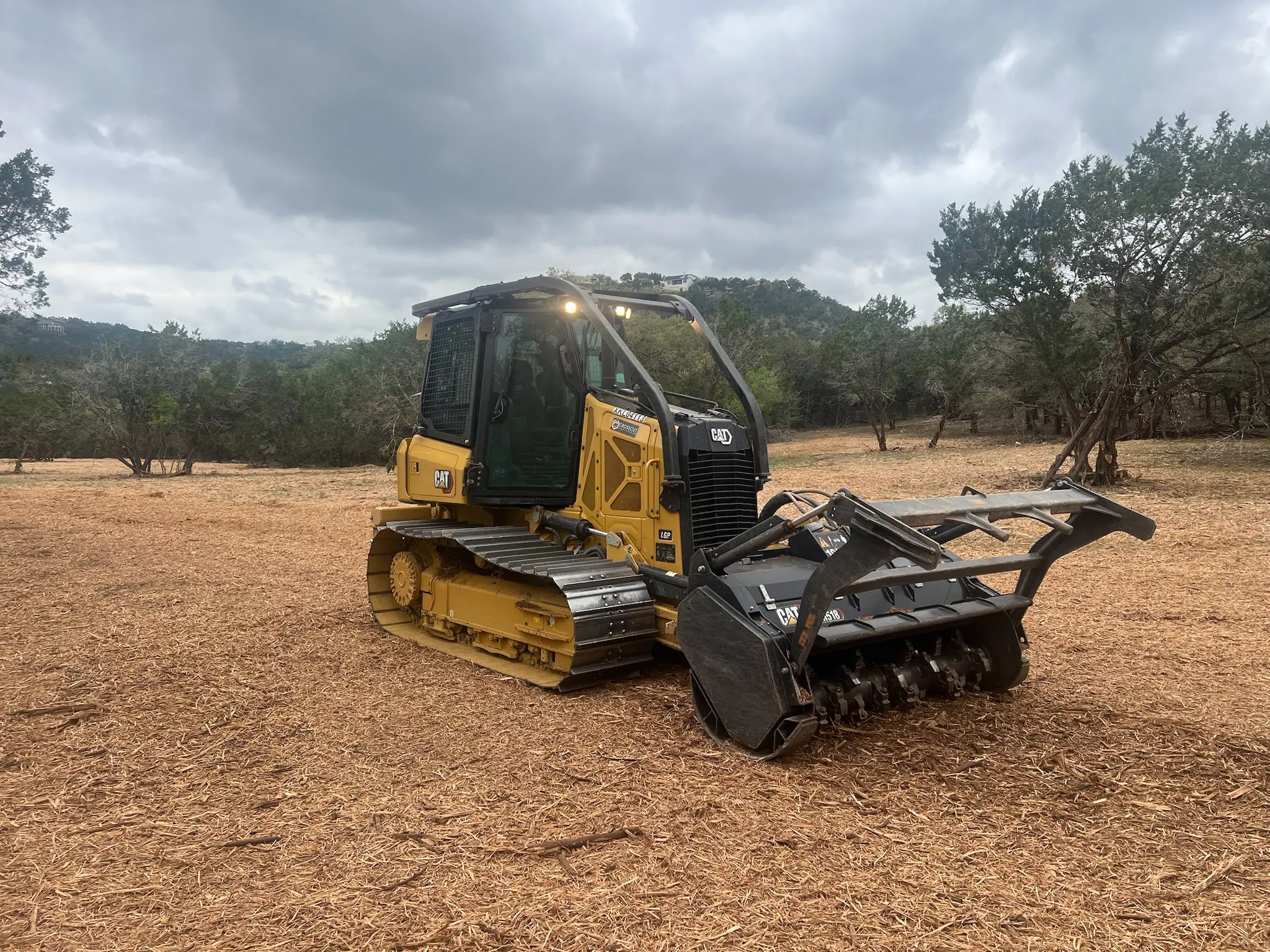
  1. Cat D1 dozer fitted with a mulching head on freshly mulched ground01

    Compact tracked mulcher

    Cat D1 dozer mulcher

    low ground pressure
    Tracked
    head
    Mulching

    A small dozer carrying a mulching head. It gets into fence rows, trails and tight timber where a big wheeled mulcher would crowd the trees you’re keeping.

  2. Green Timberpro TL725C tracked carrier with a red boom-mounted mulching head04

    Tracked boom mulcher

    Timberpro TL725C

    carrier
    Tracked
    mulching head
    Boom

    The mulching head rides on a boom, so it reaches over drainages, fence lines and steep ledges while the tracks stay on stable ground.

  3. Tigercat M726G wheeled forestry mulcher with its mulching head down05

    The big mulcher

    Tigercat M726G

    carrier
    Wheeled
    mulching head
    9 ft

    Built for forestry mulching. It turns dense cedar, heavy brush and standing timber into a mulch layer on open acreage.

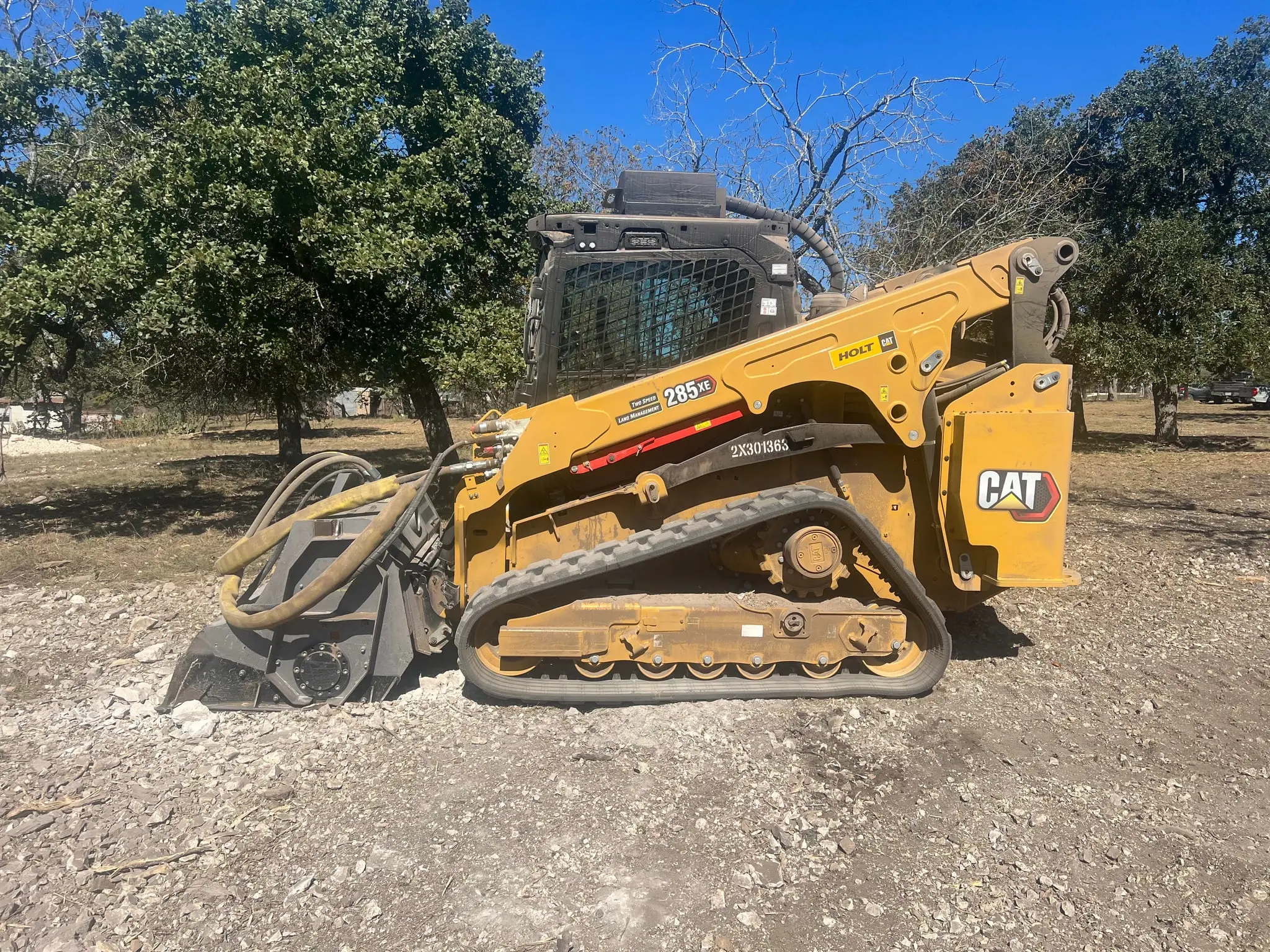
  4. Cat 285 XE tracked skid steer with a mulching head attachment on rocky Hill Country ground06

    Tracked skid steer

    Cat 285 skid steer

    attachments
    3
    carrier
    Tracked

    Swaps between a grapple bucket, a rock crusher and a mulching head, so one machine can mulch a homesite, crush the rock and clean up the debris.

    Attachments

    • Grapple bucket
    • Rock crushing attachment
    • Mulching head
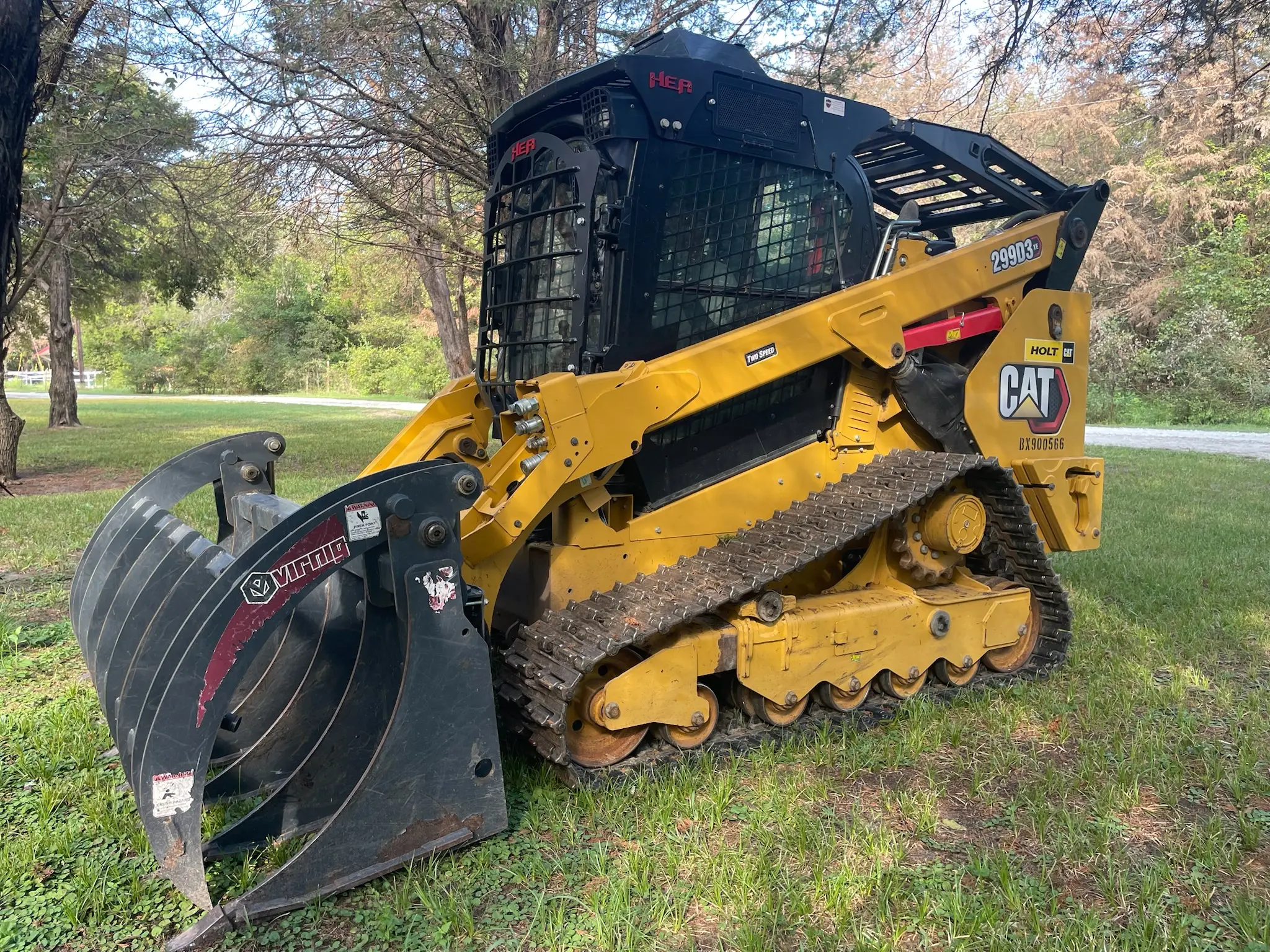
  5. Cat 299 tracked skid steer with a grapple bucket attachment07

    Tracked skid steer

    Cat 299 skid steer

    attachments
    3
    carrier
    Tracked

    The grapple moves brush and logs, the rock crusher turns limestone into usable base for pads and drives, and the mulching head handles brush around structures.

    Attachments

    • Grapple bucket
    • Rock crushing attachment
    • Mulching head

See the whole Crosscut fleet

Reviews

Landowners say it better than we do

  • “If you need land cleared this is the company to call. They are professional and they do what they say they will.”

    Karen C.Landowner, Liberty Hill, TXCrosscut customer

  • “We had Julio clean up a new fence line, 1/2 mile long, and clear an area about 2 acres where our house is to be built. He also did a partial clearing on a couple of acres behind the house, just took out the low brush and left the larger trees.”

    Colin H.Google review

  • “Exactly what I was envisioning for my land. Jordan and Christian were excellent managers of the project and Julio is about the finest operator I have ever seen in his execution and creativity of the plan.”

    Matthew C.Google review

Read more landowner reviews

Questions

Forestry mulching questions, answered

Still wondering about your property? An owner will answer it on site.

(512) 890-2555
Is forestry mulching better than traditional land clearing?

In a lot of cases, yes. It disturbs the ground less, skips the burning and hauling, and leaves mulch behind to protect the soil. Where stumps or roots have to come out for a build site or a planted field, we pair it with dozer work.

What happens to the mulch after you leave?

It stays on the ground as cover. Over time it breaks down into the soil, holding moisture and adding organic matter along the way. Grass usually starts coming up through it on its own once rain reaches the ground.

Will the brush grow back after mulching?

Cedar and most other species cut to the ground won’t re-sprout. Mesquite is the big exception: it comes back from the root, which is why we grub mesquite instead of mulching it. New seedlings can still blow in over the years.

What is mosaic cutting?

It’s mulching in a pattern instead of clearing everything. Clumps of trees and brush are left as islands with open ground between them, so you get room to move and see while wildlife keeps cover and edges to feed along.

Can you mulch on steep or rocky slopes?

Yes. The Timberpro TL725C is built for steep, rocky and tight ground, with a mulching head on a boom that reaches out from solid footing. Mulch left on a slope also helps keep the soil from washing off in the next storm.

Can forestry mulching be done any time of year?

Yes. Because nothing gets burned, mulching isn’t tied to a burn season or a county burn ban. On properties with oaks, we still follow Texas A&M Forest Service oak wilt guidance on when and how we work near them.

Ready for forestry mulching? Walk the land with an owner.

Free on-site estimate. Straight plan, fair price, before a machine rolls in.

  • Free on-site estimates
  • Mon–Sat, 8:00am–5:00pm
Call nowFree estimate