
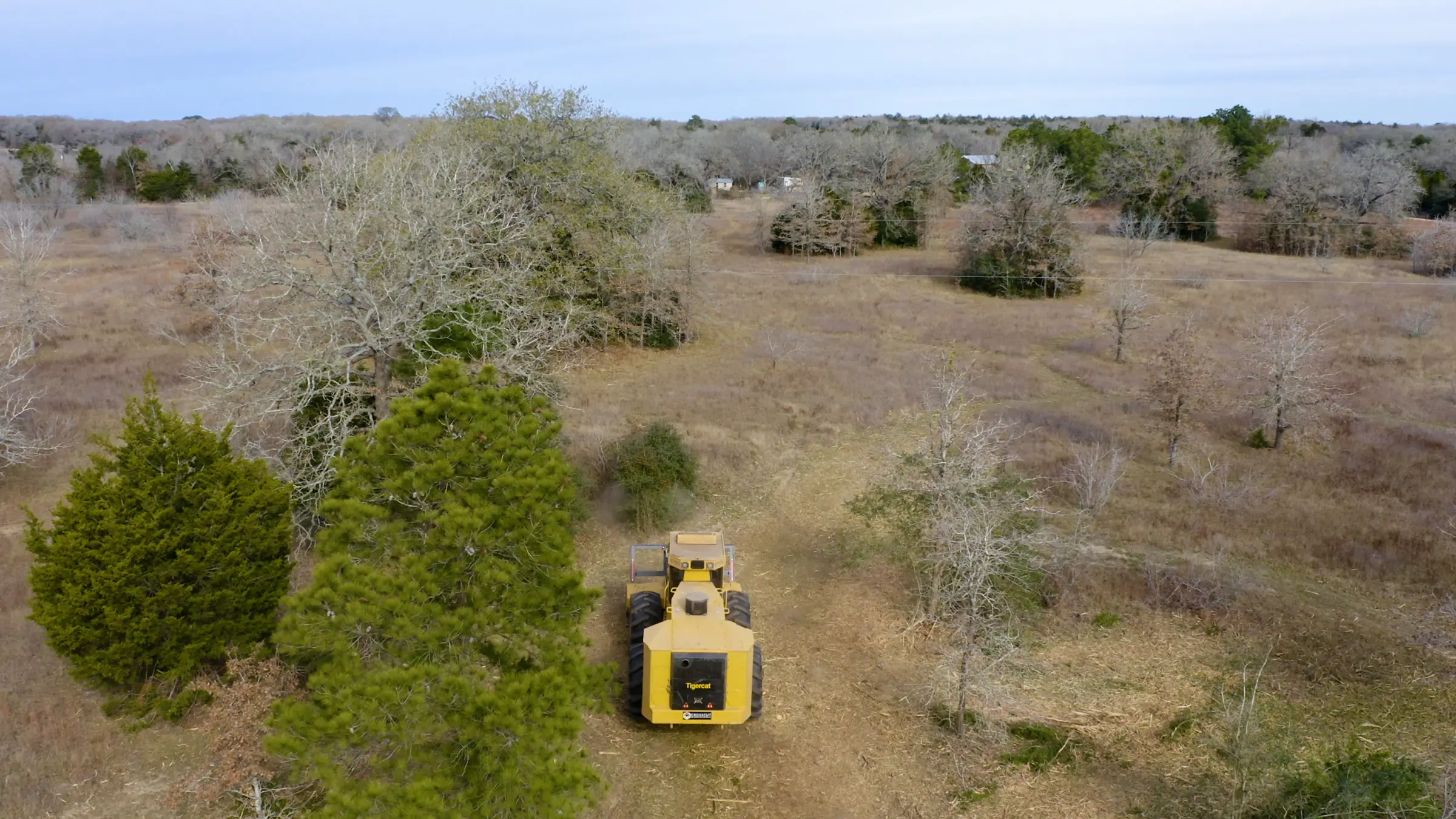
San Saba County calls itself the Pecan Capital of the World, and the bottoms along the San Saba and Colorado rivers show why. Above them, limestone uplands spread out in mesquite, juniper and live oak ranch country. In the southeast corner near Bend, the Colorado cuts through karst at Colorado Bend State Park, where Gorman Falls spills over fern-covered travertine.
Land clearing here follows that mix. Ranchers around Richland Springs and Cherokee fight mesquite and cedar on grazing land. Pecan growers need brush kept out of orchards and fence rows without hurting trees. Hunting ranches near Bend and along the Colorado need lanes, openings and roads, and with long miles between towns, ranch roads and creek crossings take a beating after heavy rain.
Communities we work in San Saba County
- San Saba
- Richland Springs
- Cherokee
- Bend
Three kinds of ground in one county
San Saba County has deep, fertile bottomland along the San Saba and Colorado rivers, thin limestone uplands, and karst country near Bend with caves, sinkholes and springs. Bottomland floods and stays soft after rain, while the uplands are rocky and quick to erode when stripped bare.
Each needs its own plan. We work around karst features carefully, keep heavy machines off soft bottoms until they dry, and leave mulch on the uplands to hold the soil.
Pecans, pasture and hunting country
The work here includes mesquite grubbing and pasture restoration on ranches, careful brush clearing around pecan orchards, cedar mulching on upland slopes, wildlife lanes and openings on hunting land near the Colorado, and ranch road and crossing work.
Around pecans, careless clearing costs money. We plan machine paths away from trunks and root zones, bring smaller machines like the Cat D1 dozer mulcher or a skid steer with a mulching head where needed, and let hand crews finish close to the trees.
Floodplain, warblers and dry summers
Most of the county is unincorporated, but floodplain rules can apply near the rivers, and oak-juniper woodland in this region can be golden-cheeked warbler habitat, where clearing is generally avoided roughly March through August. Oak wilt guidance applies to the live oaks, and burn bans are common in dry summers, when mulching keeps brush work moving.